Introduction
This is my write-up of an investigation I conducted while working through Xintra’s HuskyCorp incident simulation lab, along with what I learned throughout the process. The investigation revealed a hybrid end-to-end compromise and showed how an attacker can abuse identity in Entra ID in a variety of ways in order to escalate their privileges, maintain persistence, and effectively take over a tenant. By the end of the incident, the attacker gained administrative privileges within Entra, the on-premises Active Directory domain, and sensitive company information.
Executive Summary
In late April 2024, Husky Corp triggered an incident response investigation after discovering suspicpious user activity within their Azure tenant. The investigation revealed that a threat actor was able to to gain control over several identities, applications, and workstations. The threat actor was also able to successfully access sensitive business information.
Based on the tactics, techniques, and procedures observed, the activity aligns closely with publicly reported Midnight Blizzard (APT 29) tradecraft. These operations are commonly associated with intelligence collection and long-term access rather than disruptive activity.
This case study analyzes how a threat actor like Midnight Blizzard leverages identity mechanisms within Entra ID to maintain persistence and escalate their privileges.
Environment & Scope
Husky Corp’s environment consists of an Azure tenant integrated with Entra ID with various Azure resources and an on-premises Active Directory forest.
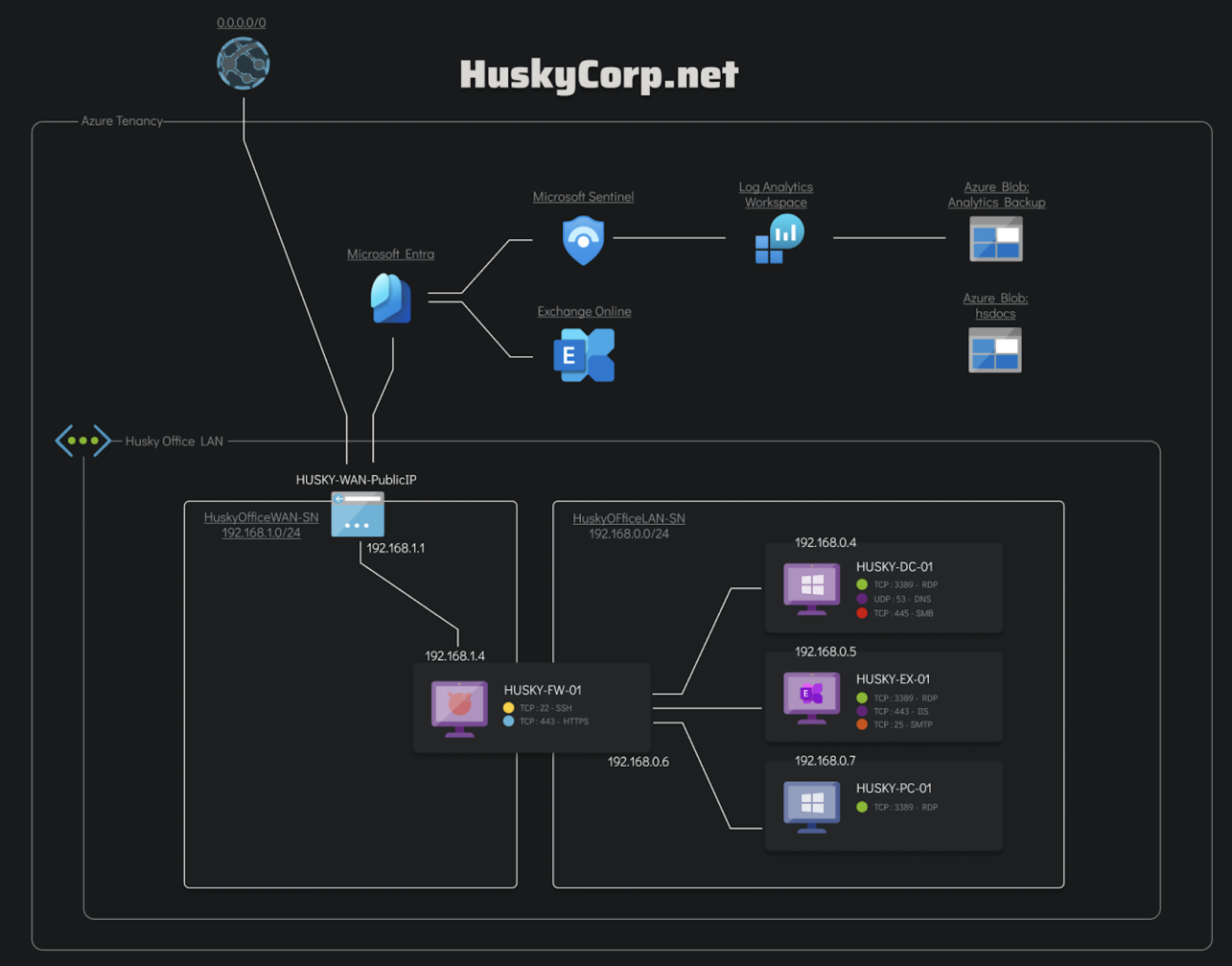
Responders were provided with access to an ELK instance with pre-parsed logs, exported email artifacts, parsed browser outputs, and parsed KAPE outputs.
The scope of this investigation was limited to artifacts provided within the simulation, including Entra ID sign-in and audit logs, Azure Activity Logs, Microsoft Graph telemetry, Windows host event logs, and parsed forensic outputs. Live containment actions and external infrastructure attribution were outside the scope of this analysis.
Attack Analysis
The following section provides an analysis of the different phases the threat actor executed, and the ramifications of such activities.
Initial Detection
The incident began on April 20th, 2024 with multiple failed login attempts for the users Ashlee@huskycorp.net, Lonnard@huskycorp.net, and lina@huskycorporation.onmicrosoft.com all from the IP: 103.216.220.45. The failures were recorded with the error InvalidUserNameOrPassword, indicating an attempt at password spraying. Tools such as MSOLSpray are typically used to password spray Entra ID. The result of using such a tool is the influx of failed login attempts seen in the audit logs. This tool in particular takes note of the error codes returned from a failed login attempt, meaning that in instances where the credentials are correct but some other factor is blocking a successful login, the threat actor can use that information to adapt their approach.
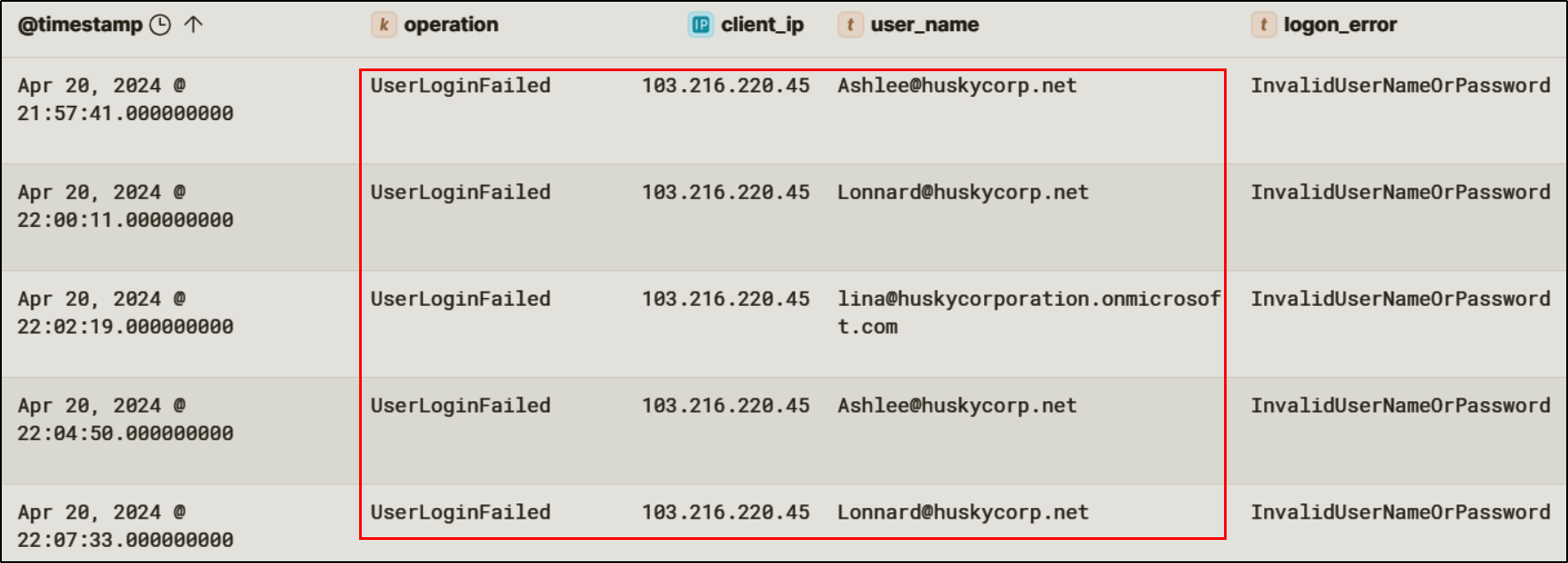
This activity warranted further investigation into whether any credentials had been successfully validated.
Identity Compromise
Credential Validation
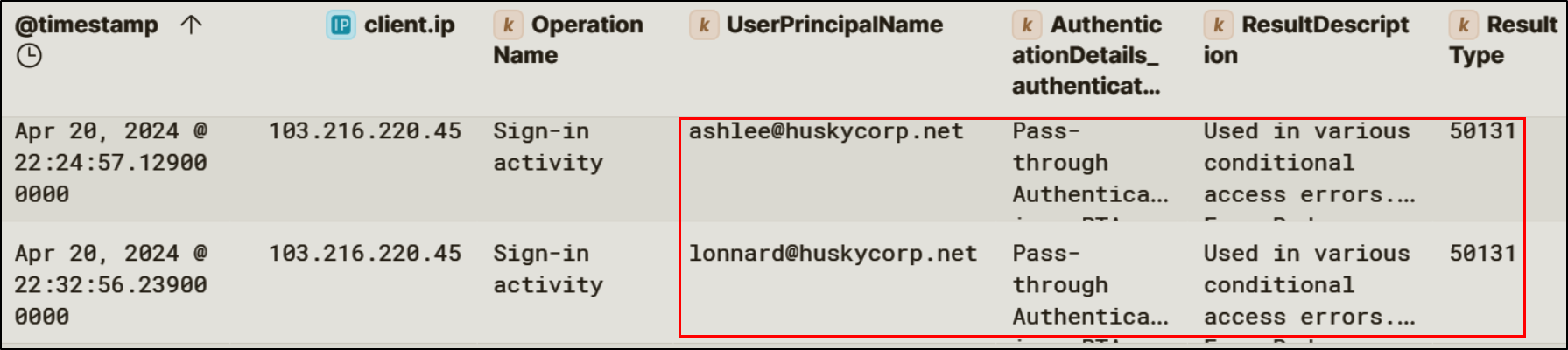
Analysis of Entra ID sign-in logs show that the attacker was able to successfuly validate the credentials for two users: Lonnard@huskycorp.net and Ashlee@huskycorp.net. Both Ashlee and Lonnard were using Pass-Through-Authentication, meaning that these users’ passwords are validated through an on-premises agent rather than authenticated through the cloud.
Conditional Access Behavior
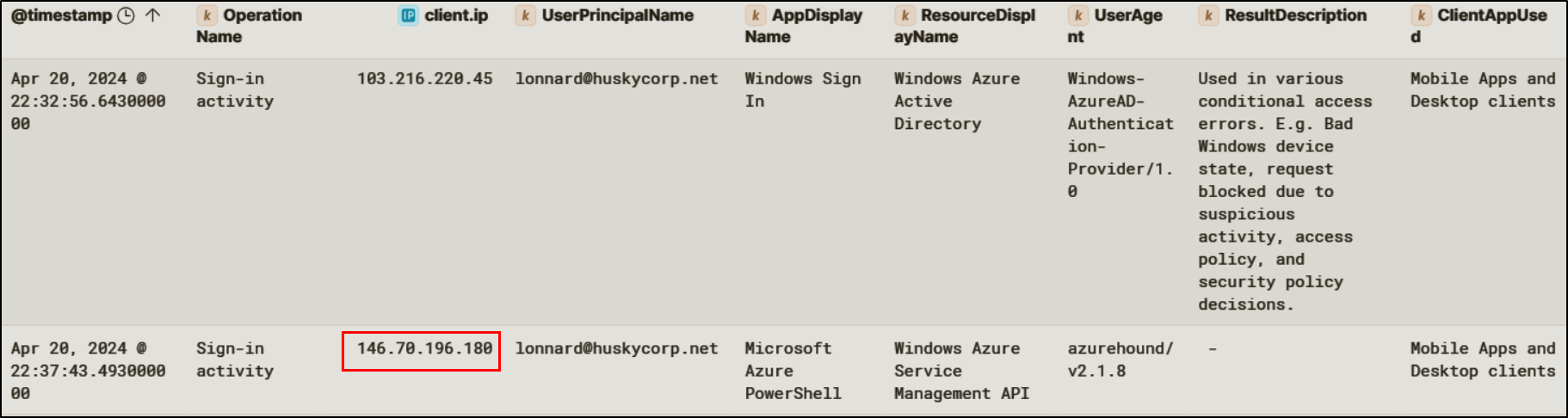
Although the attacker was able to obtain the credentials for Lonnard’s and Ashlee’s accounts, the login attempt is blocked by the Conditional Access policies.
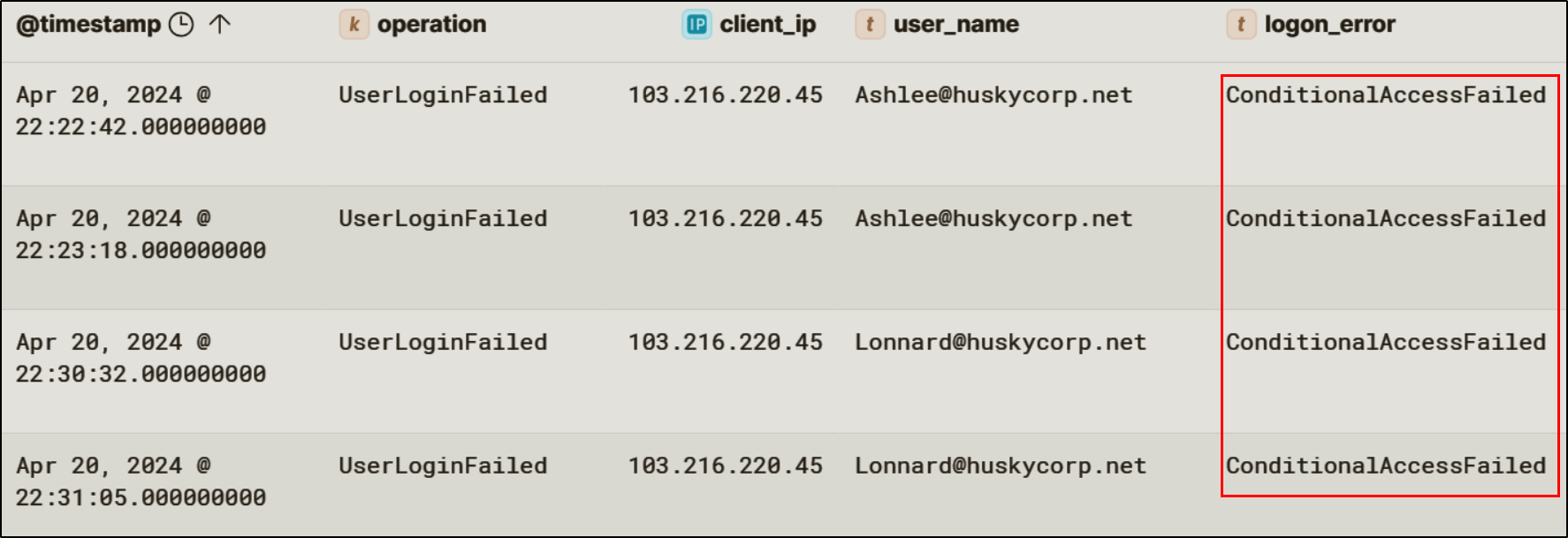
However, Conditional Access controls did not fully stop the threat actor. Subsequent successful sign-ins for Lonnard@huskycorp.net were observed originating from a different IP address (146.70.196.180), suggesting the attacker adapted infrastructure to bypass Conditional Access policies.
Token-Based Access and Tenant Enumeration
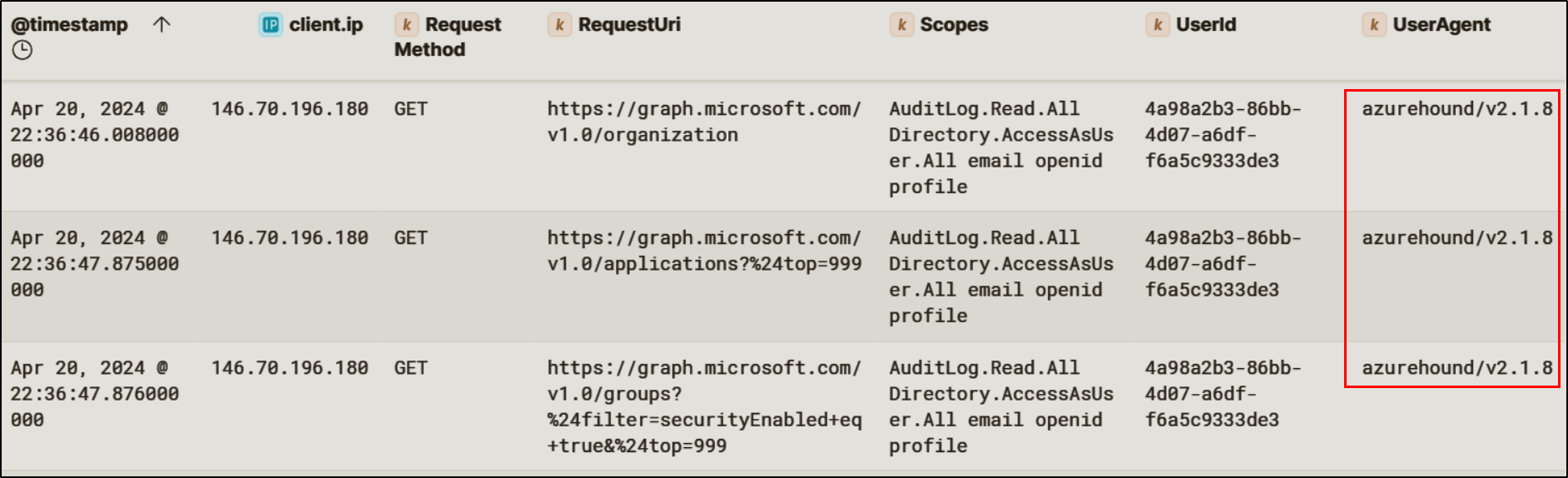
Following successful authentication as Lonnard@huskycorp.net, sign-in activity was observed with the user agent azurehound/v2.1.8. AzureHound is a Microsoft Graph enumeration tool commonly used to map identity relationships, role assignments, and application permissions within Entra ID. Audit logs confirmed that shortly after this authentication event, the attacker initiated multiple Microsoft Graph API requests targeting directory objects, applications, and role assignments.
Persistence Mechanisms and Data Exfiltration
After the attacker’s initial reconnaissance, they focused on establishing persistence within Entra ID using cloud-native mechanisms. These techniques allowed the threat actor to maintain access without solely relying on credentials while also reducing the effectiveness of remediation actions like password resets or MFA enforcement.
OAuth Abuse
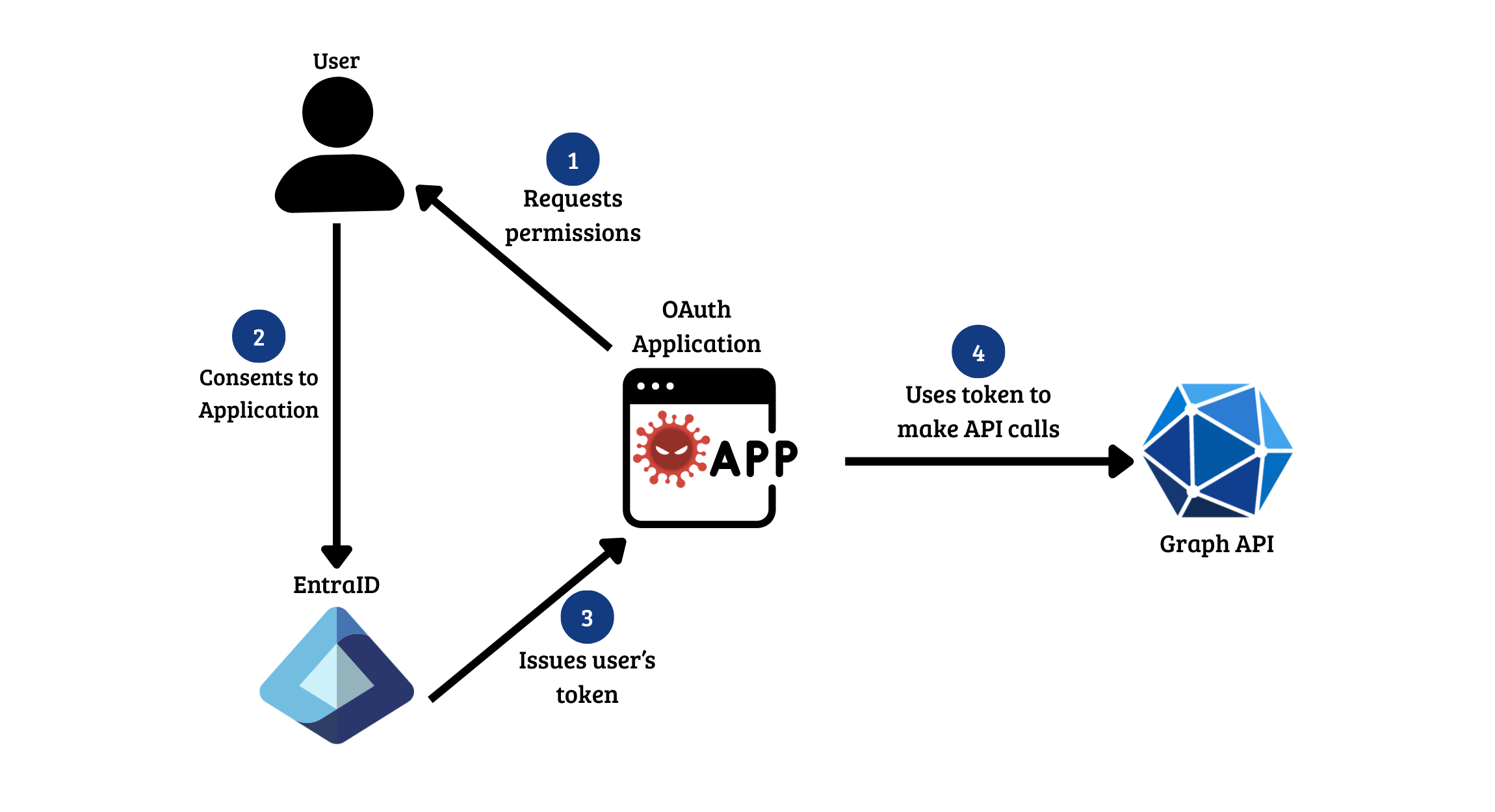
An OAuth application in Azure authorizes software to access resources on behalf of a user without the need for a password. Attackers commonly use social engineering in order to trick legitimate users into authorizing a malicious app as a form of persistence. A typical attack flow looks like this:
In this incident, the threat actor used a phishing email targeting Lonnard@huskycorp.net to obtain OAuth consent for a malicious application named Calendar-Sync. The email directed the user to an OAuth authorization endpoint requesting delegated Microsoft Graph permissions.
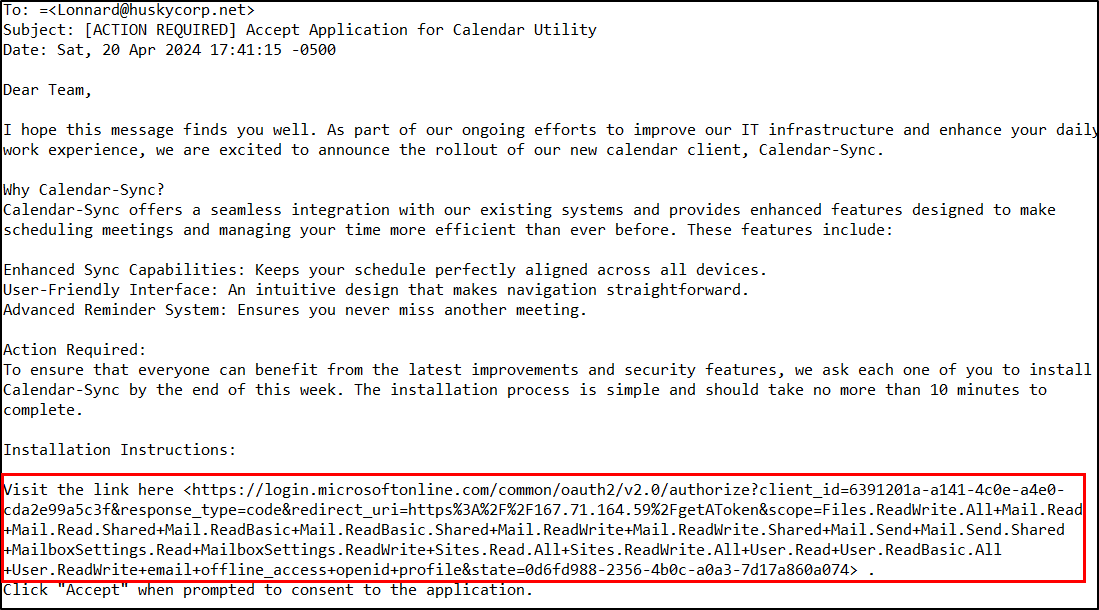
The initial consent attempt was blocked by Microsoft security controls. This failure triggered an admin consent workflow, meaning a pending approval request was generated. An admin user ended up approving the consent request, adding Calendar-Sync as a service principal in the tenant.
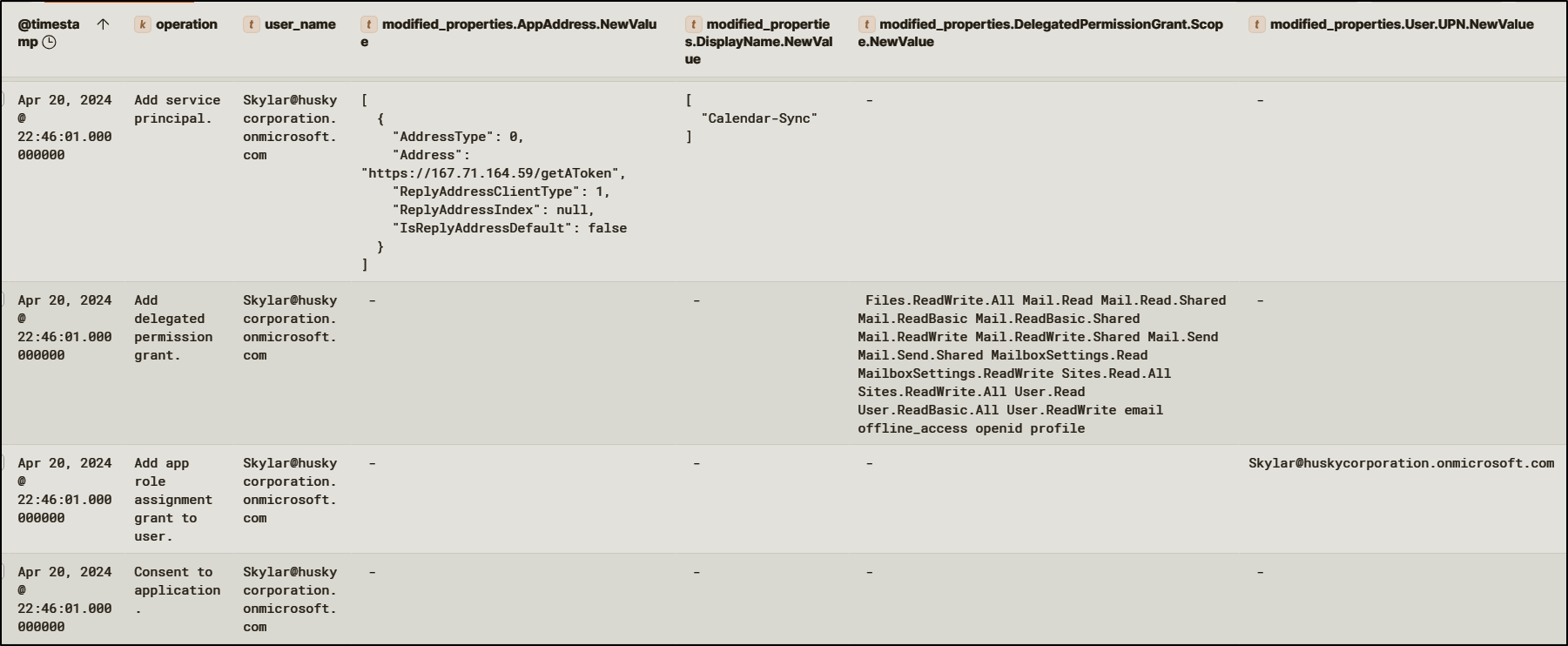
Once consent was granted, Entra ID issued refresh tokens to the application when Lonnard@huskycorp.net authenticated.
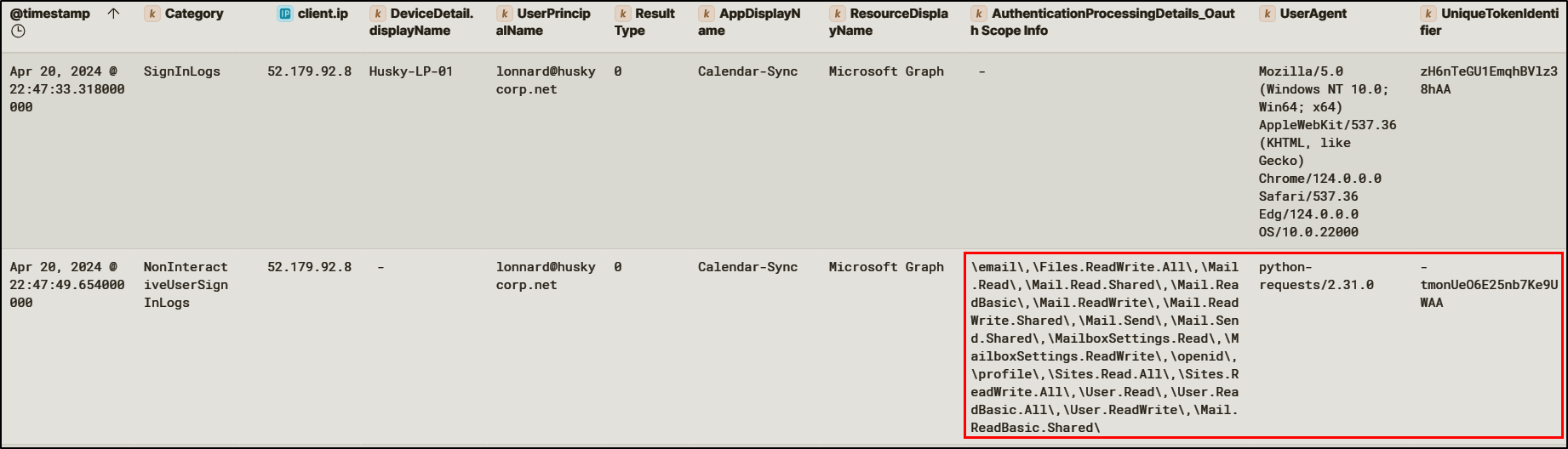
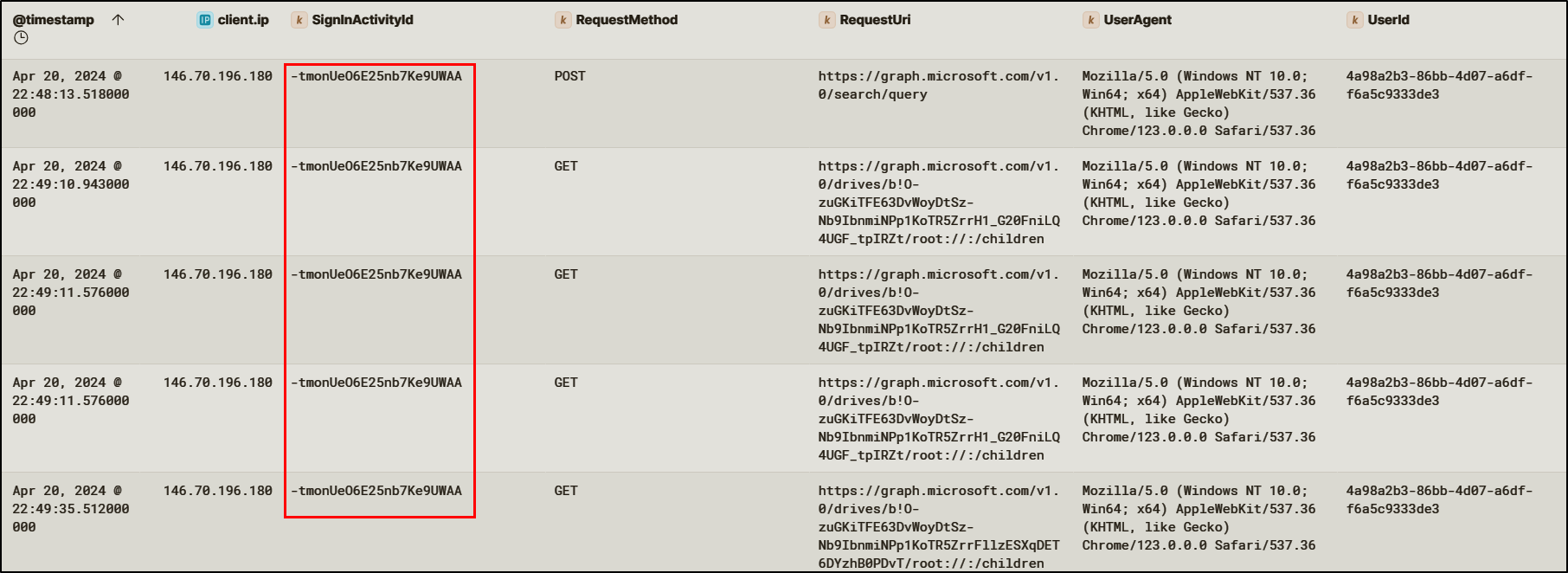
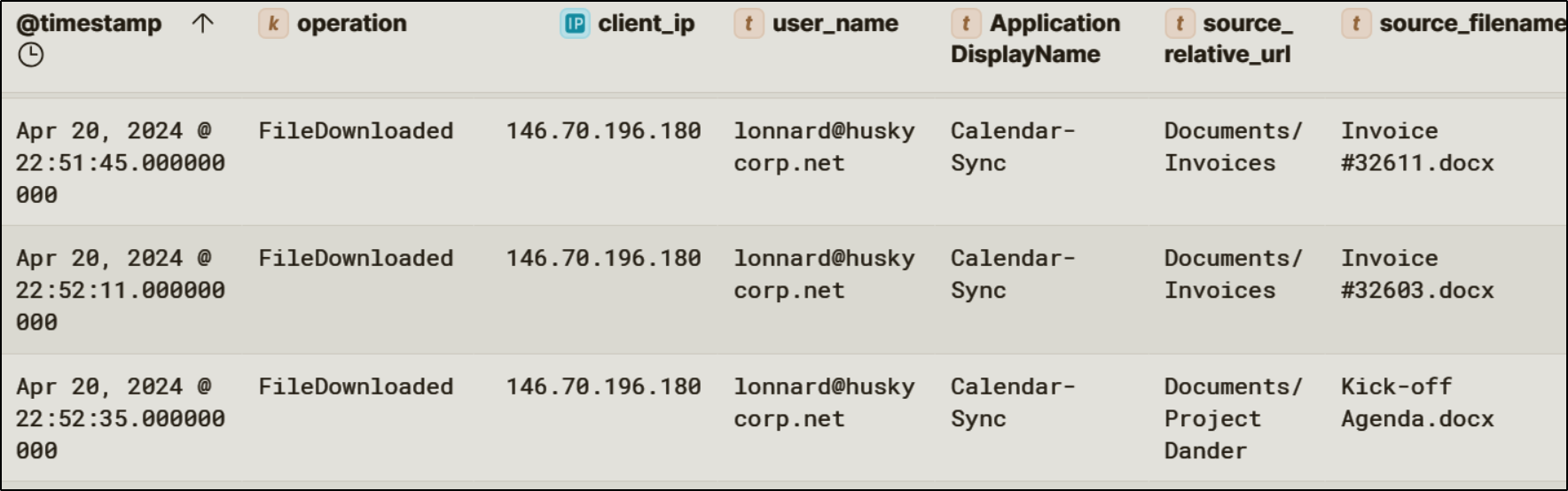
After persistence was established, the attacker then used this access to exfiltrate sensitive business information, downloading several files from SharePoint.
Inbox Rules
Using the privileges gained through Calendar-Sync, the attacker created a hidden inbox rule within Lonnard@huskycorp.net’s mailbox. The rule silently forwards emails containing the term “shareholder report” to an external ProtonMail address controlled by the attacker.

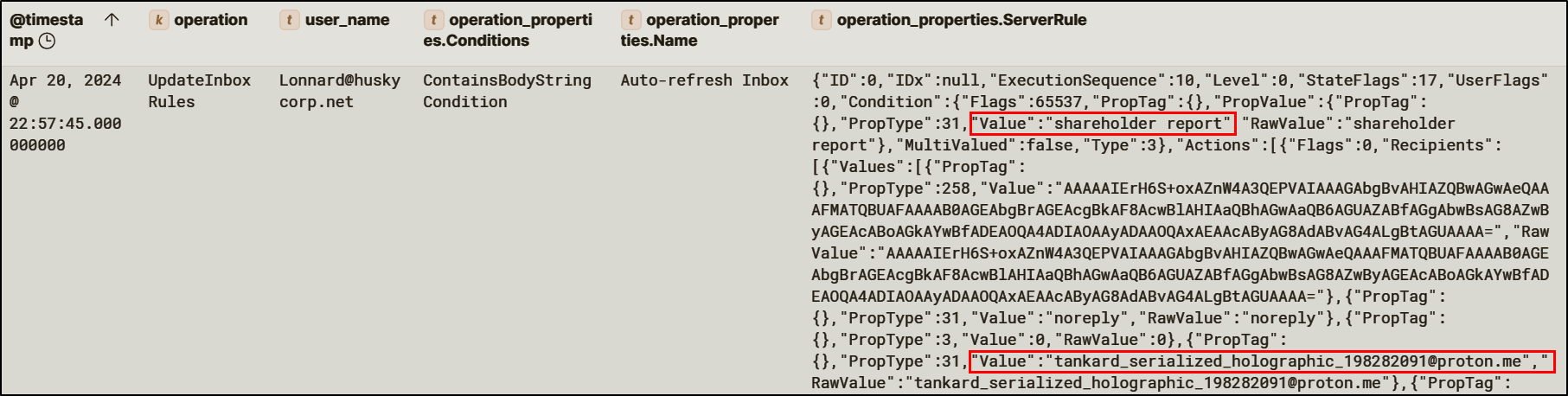
Hidden inbox rules is a common Business Email Compromise (BEC) technique that allows attackers to stealthily exfiltrate data over time.
Application Ownership Abuse
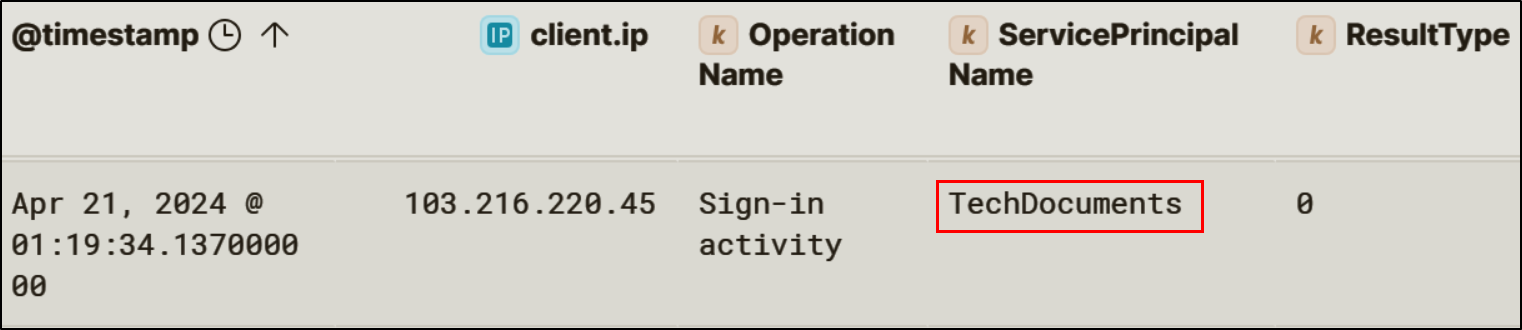
Using credentials for the user Ashlee@huskycorp.net, previously obtained during the initial password spray, the attacker modified ownership and credentials for an existing Entra ID application named TechDocuments. The attacker added the compromised user as an application owner and created a new client secret for the application.
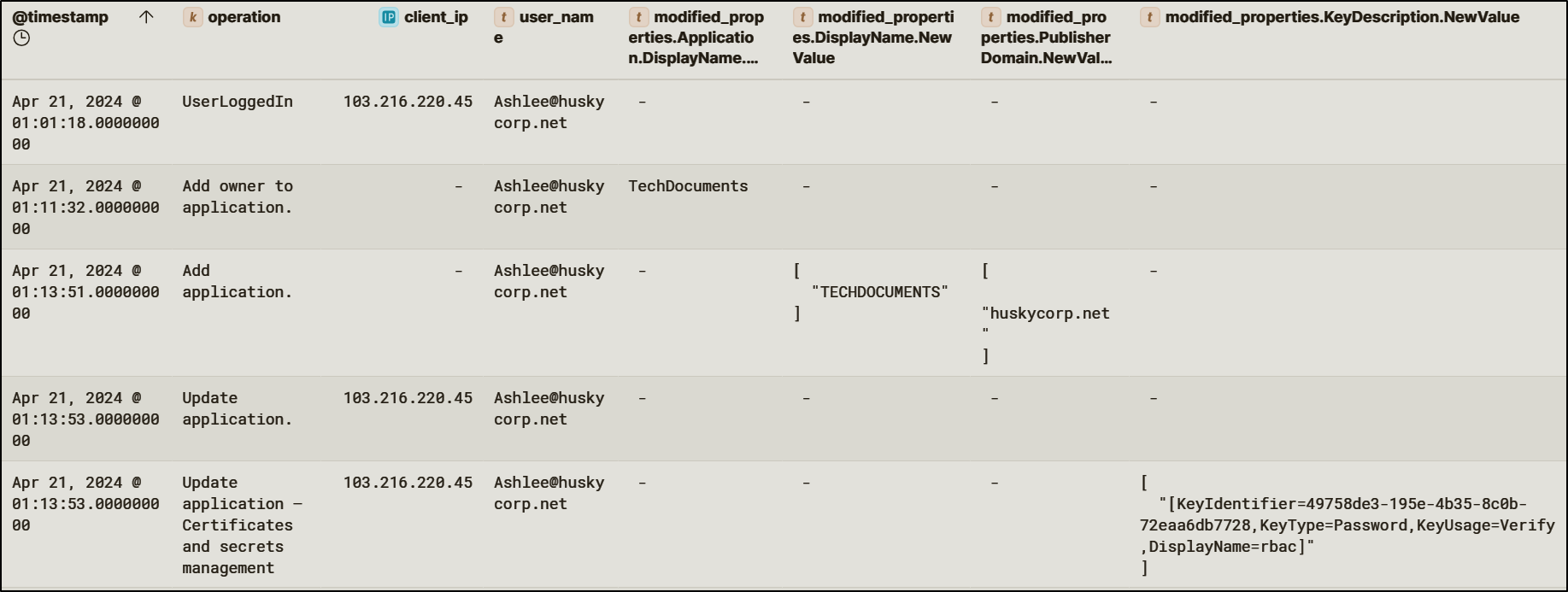
This technique allows attackers to authenticate as the application itself.
Federated Domain Backdoor
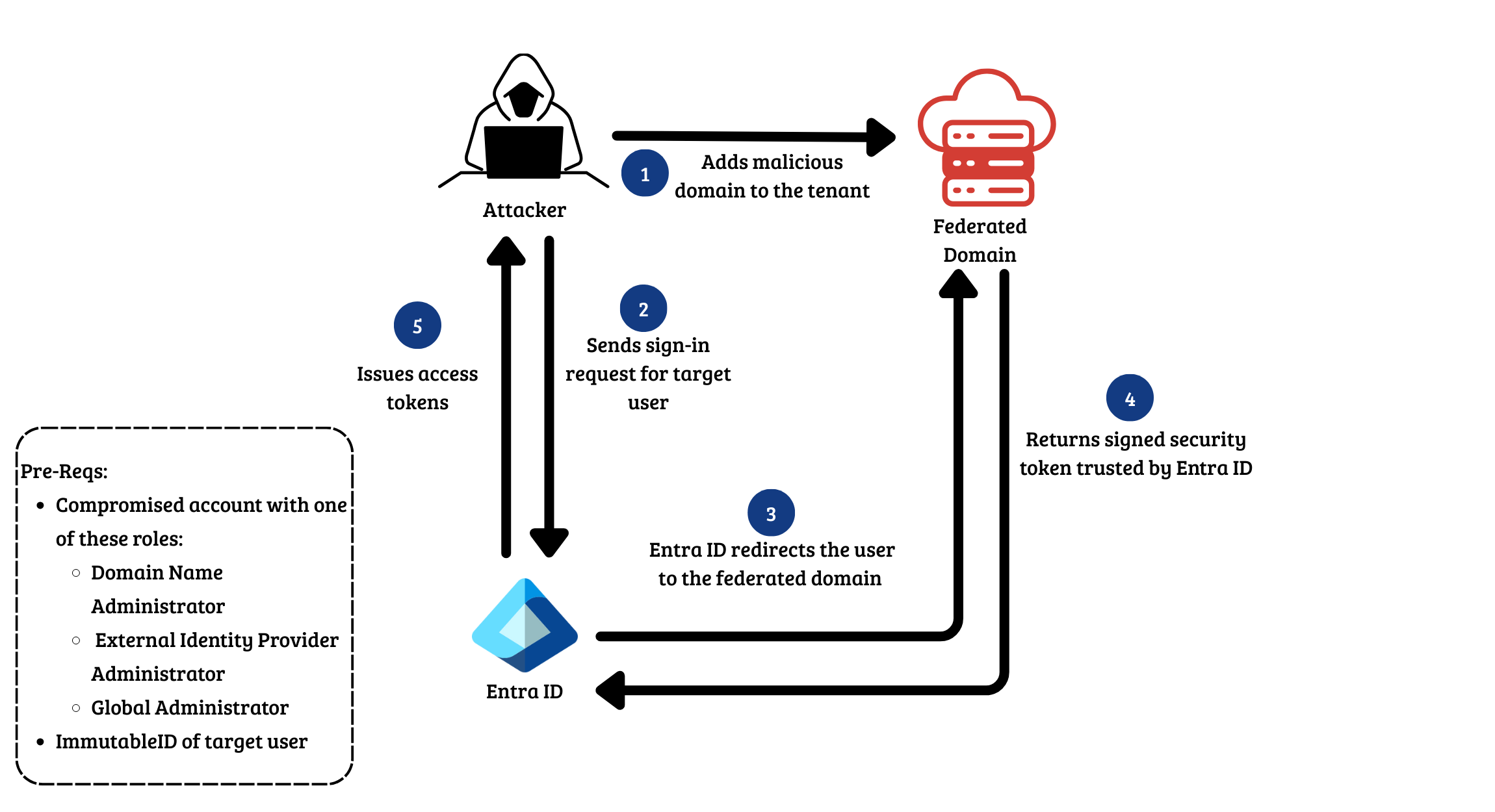
The threat actor added a new federated domain, huskyhelpdesk.store, to the tenant. The domain was configured with a malicious issuer URI, enabling token issuance from an attacker-controlled identity provider.
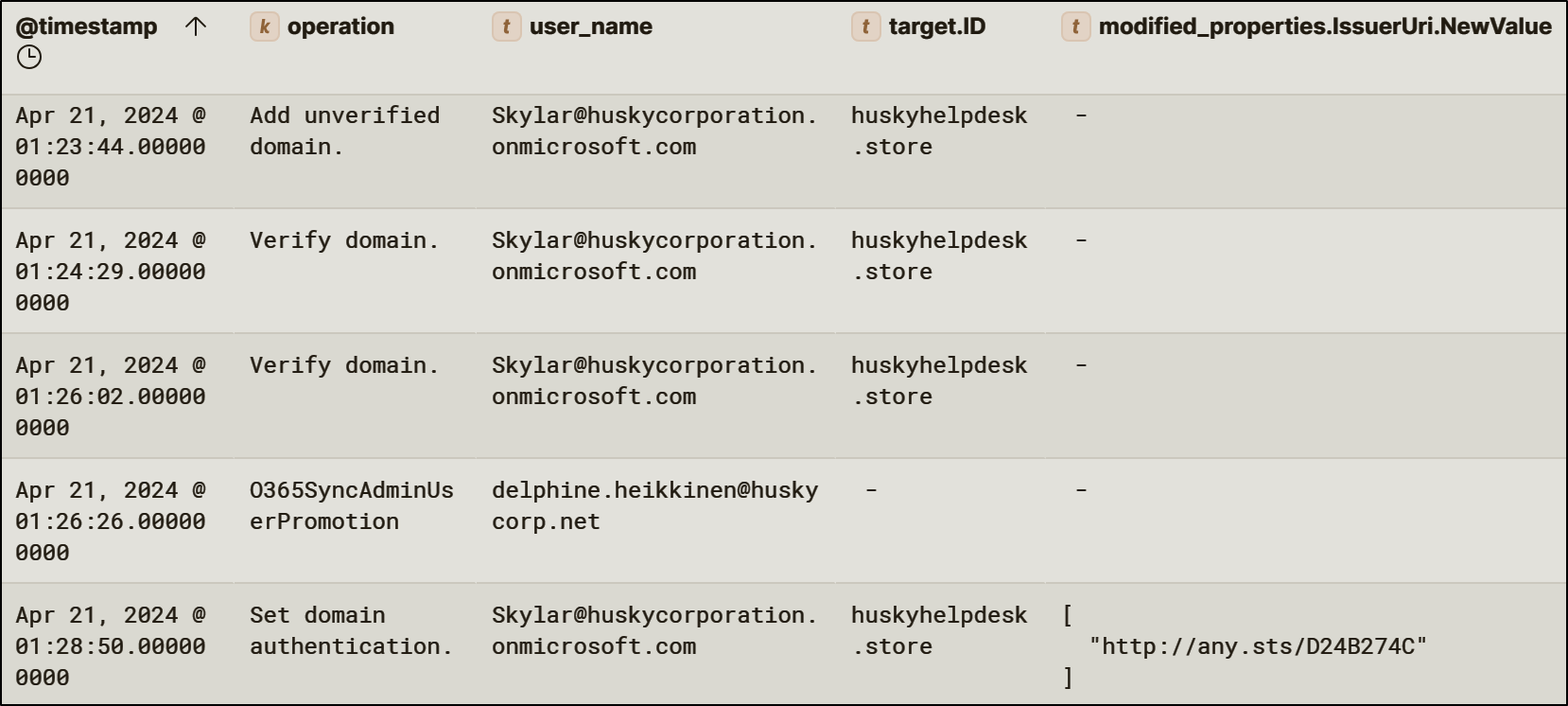
By adding a federated domain, the attacker can redirect the authentication flow so that authentication is performed by the new federated domain rather than directly by the tenant itself. This means that the threat actor is able to impersonate any user without their credentials and bypassing MFA.
Privilege Esclation
Managed Identity Abuse
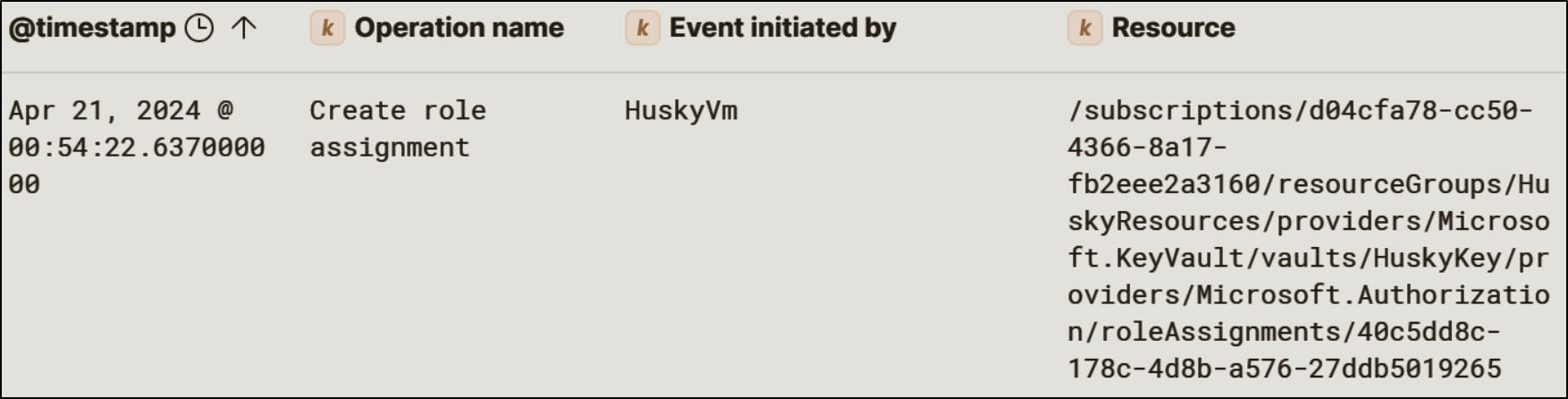
The threat actor authenticated to the Azure virtual machine HuskyVM and leveraged the VM’s managed identity to access Azure resources. The attacker identified a Key Vault named HuskyKey. The attacker then assigned the Key Vault Administrator role to the managed identity at the Key Vault scope, effectively granting full control over secret management.
Key Vault Access
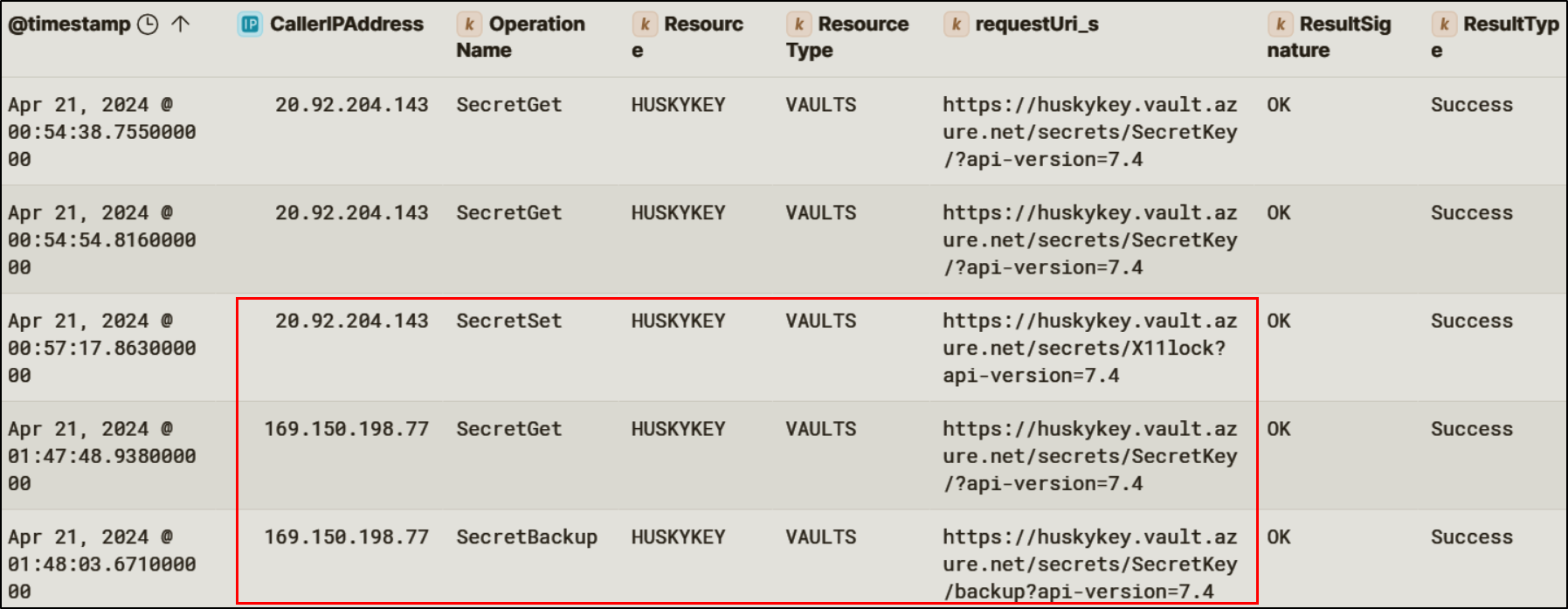
With administrative access to the Key Vault, the attacker listed available secrets and retrieved the value of a sensitive secret named SecretKey.
On-Prem Compromise
After establishing control within the cloud identity plane, the attacker pivoted into the on-premises environment.
Internal Phish
The attacker initiated an internal phishing campaign by uploading a malicious document to SharePoint and distributing it to Lonnard@huskycorp.net. The email impersonated executive communications and prompted the user to open an attached archive file.
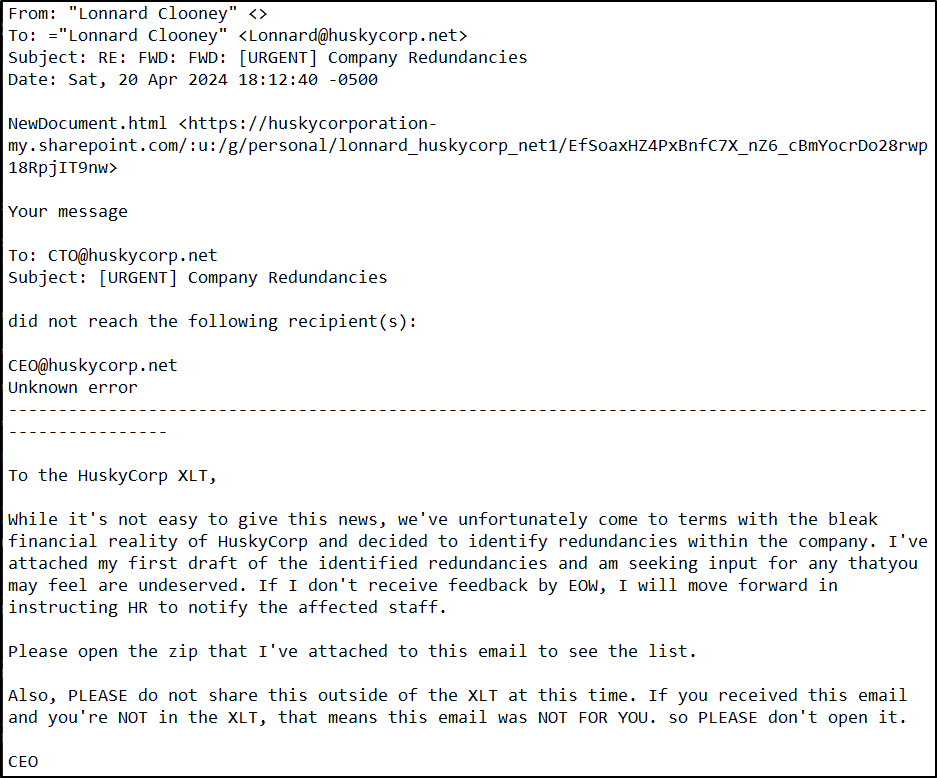
The archive contained an ISO image with a malicious DLL and a shortcut file. When executed, the shortcut spawned cmd.exe and used rundll32.exe to trigger execution of the malicious DLL.
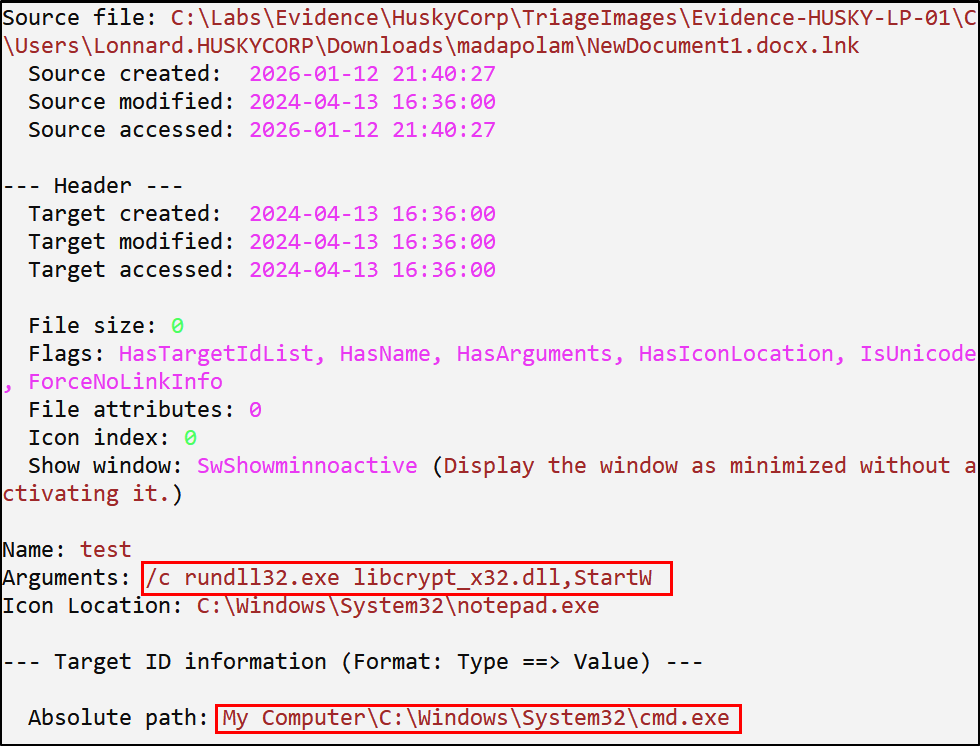
DLL Execution and Credential Access
Following execution, the malicious DLL initiated outbound network connections over port 80 to a malicious IP and started local Office applications.
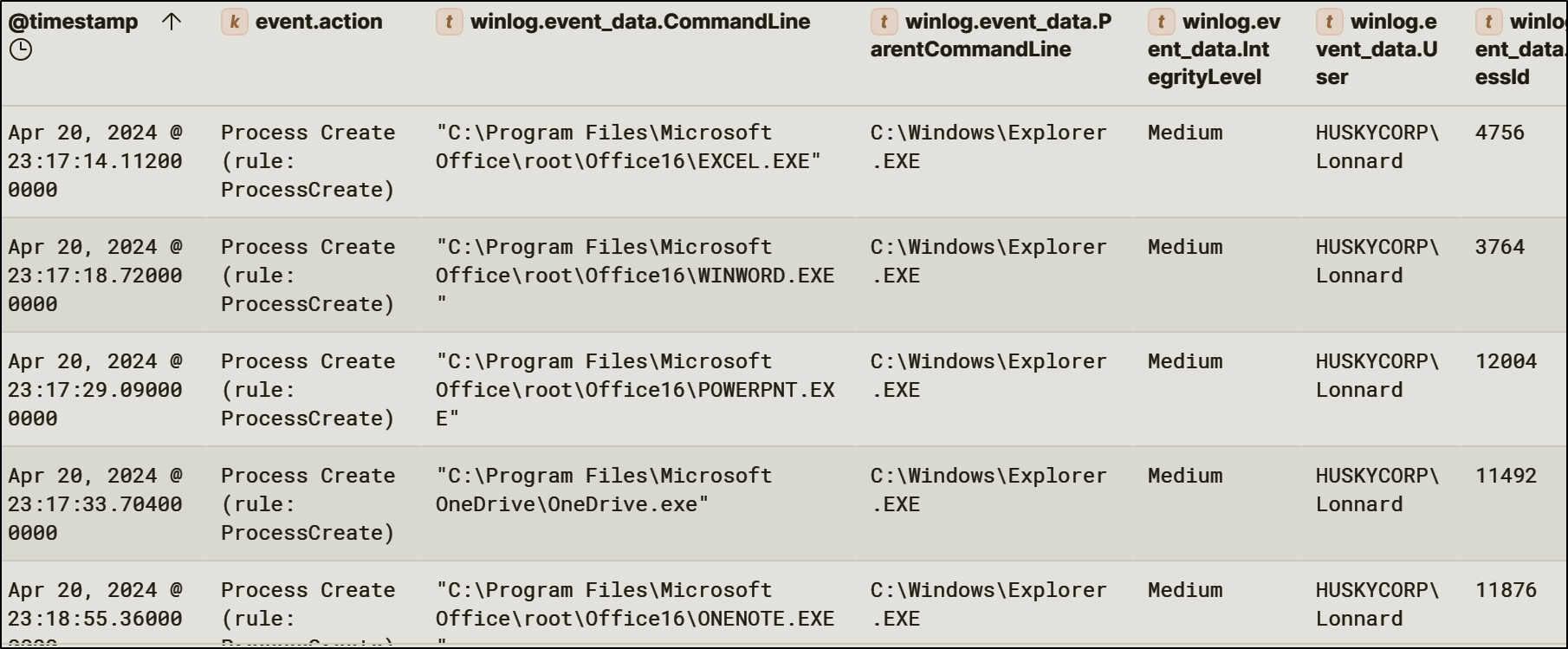
Because Office applications automatically authenticate to Entra ID, access and refresh tokens were present in memory. The attacker dumped memory from these processes, producing .dmp files containing authentication artifacts. This technique enabled the attacker to extract tokens without needing to capture credentials directly, reducing reliance on password-based access.
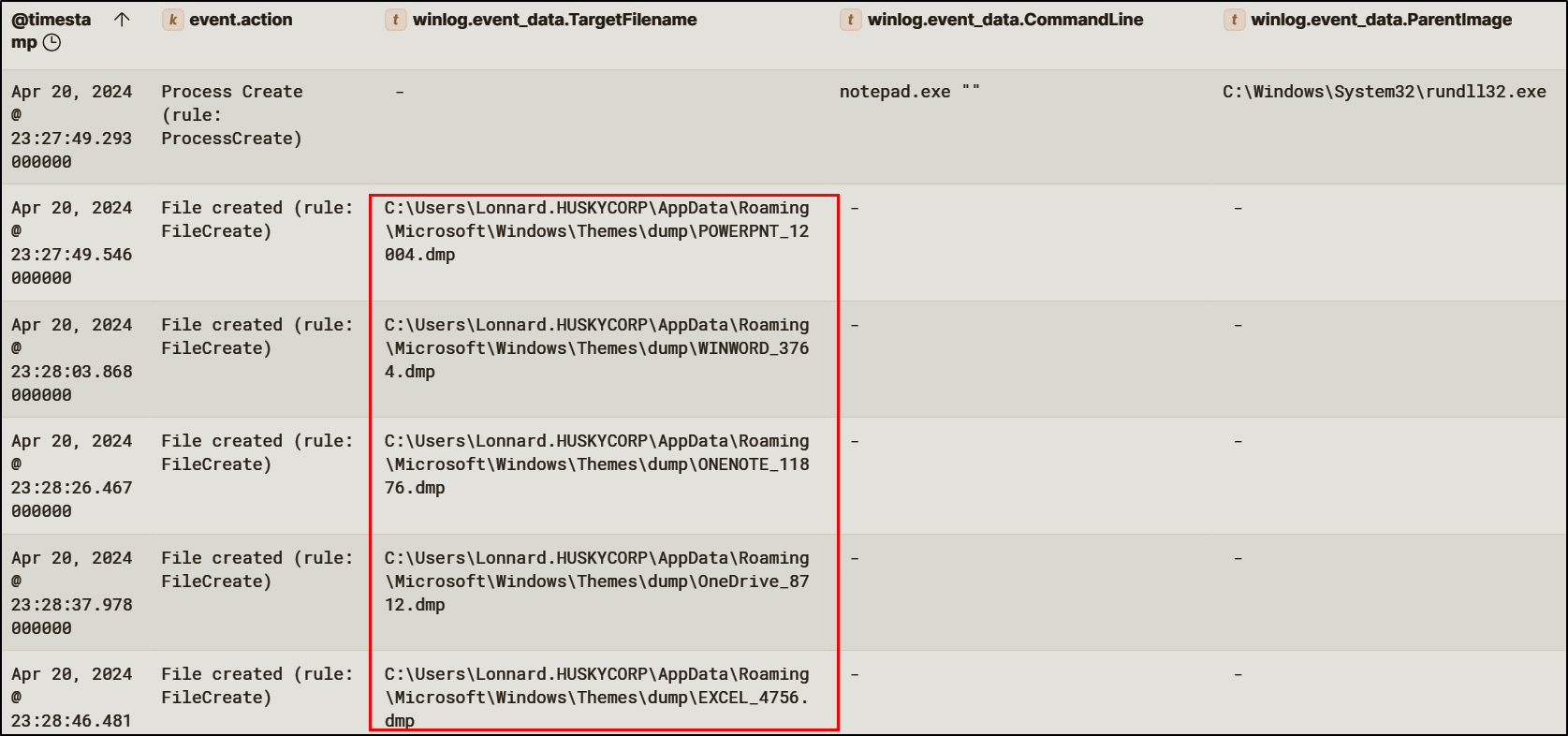
Domain Controller Access
Using stolen tokens and elevated privileges, the attacker moved laterally to the domain controller using Impacket’s wmiexec.py. This provided remote command execution under high-privilege context.
Once access was established, the attacker conducted reconnaissance, deployed additional tooling, and ultimately cleared Windows event logs and disabled Unified Audit Log ingestion. These actions were consistent with anti-forensic behavior intended to hinder incident response and obscure the full scope of the compromise.
PRT Theft
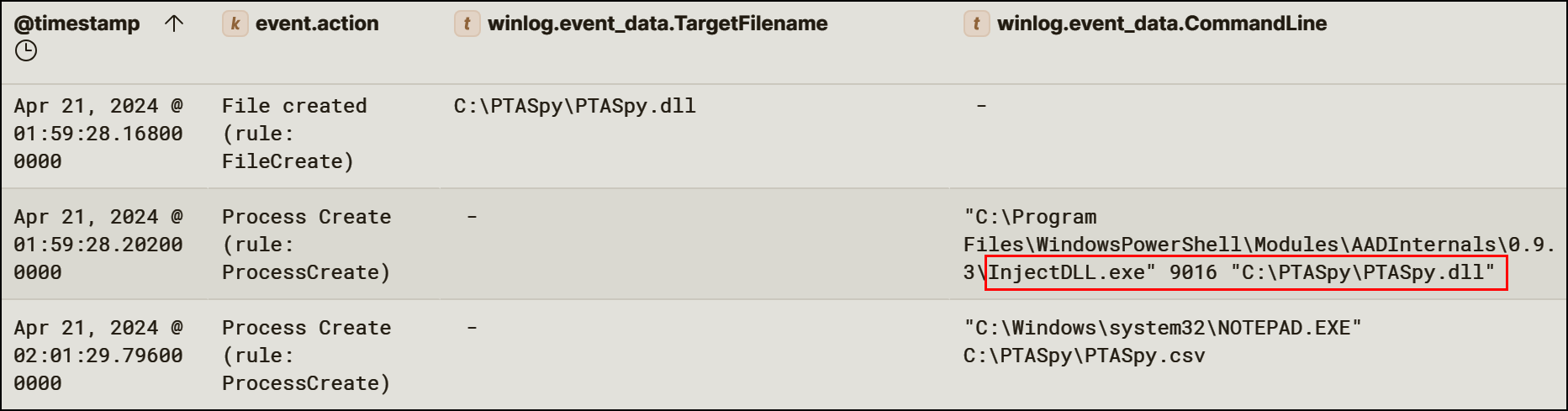
Further analysis revealed evidence of Primary Refresh Token (PRT) theft. A PRT is a user’s identity token that can be used to obtain new access tokens. PTASpy is a tool that extracts PRTs from memory in hybrid environments that use PTA.
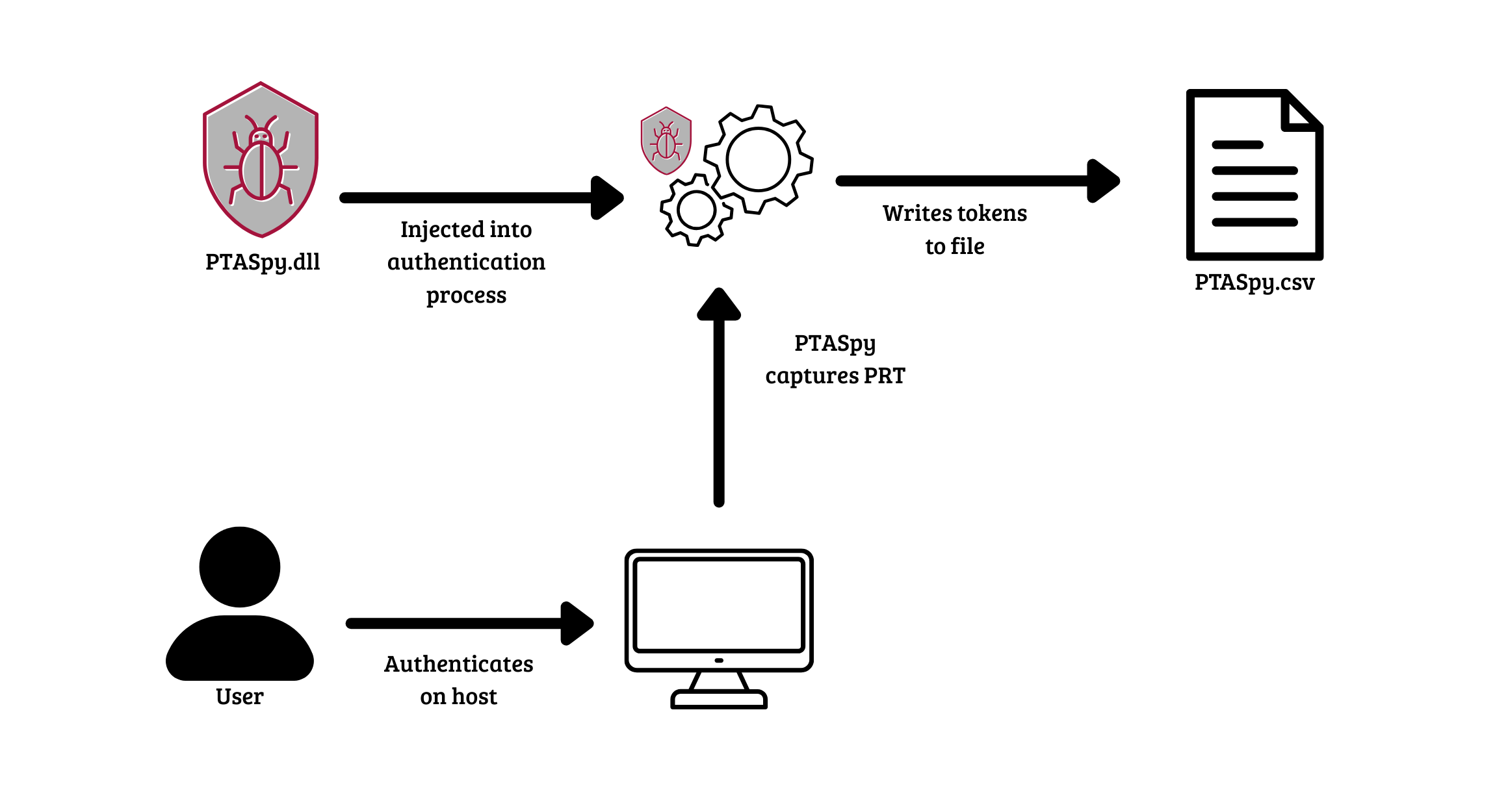
PRT theft allows attackers to mint new access tokens on demand across Entra-integrated services, effectively bypassing MFA and Conditional Access controls. This represents one of the most severe identity compromise techniques in hybrid Azure environments.
Reconstructed Timeline
The table below reconstructs the attacker’s activity in chronological order based on cloud and on-premises telemetry.
| Time (UTC) | Event | Notes |
|---|---|---|
| 2024-04-20 21:57 | Multiple failed authentication attempts against Ashlee, Lonnard, and lina from IP 103.216.220.45 |
Password spraying behavior |
| 2024-04-20 22:22 | Conditional Access blocks initial interactive sign-in attempts | ConditionalAccessFailed |
| 2024-04-20 22:36 | Sign-in from IP 146.70.196.180 using user agent azurehound/v2.1.8 for Lonnard@huskycorp.net |
Indicates tenant reconnaissance tooling |
| 2024-04-20 22:36 | Microsoft Graph enumeration activity begins | User, role, and application discovery |
| 2024-04-20 22:41 | OAuth consent phishing email sent to Lonnard@huskycorp.net |
Consent request for Calendar-Sync |
| 2024-04-20 22:43 | Administrative consent granted for Calendar-Sync |
Malicious service principal created |
| 2024-04-20 22:50 | Calendar-Sync downloads several files from SharePoint |
Post-compromise data access |
| 2024-04-20 22:57 | Hidden inbox rule created forwarding mail externally | Mailbox persistence |
| 2024-04-20 23:12 | Internal phishing document delivered via SharePoint to Lonnard@huskycorp.net |
Pivot to on-premises |
| 2024-04-20 23:15 | Malicious LNK executed on Husky-LP-01; DLL loaded via rundll32.exe |
Initial code execution |
| 2024-04-20 23:16 | Network Connection over port 80 to 167.71.168.227 |
Beaconing activity |
| 2024-04-20 23:16 | Office app processes dumped | Token harvesting |
| 2024-04-21 00:24 | Lateral movement to domain controller via wmiexec.py |
Remote command execution |
| 2024-04-21 00:50 | Attacker logs in to Azure VM HuskyVM |
Workload identity abuse |
| 2024-04-21 00:54 | Managed identity granted Key Vault Administrator role |
Privilege escalation |
| 2024-04-21 00:54 | Secrets exfiltrated from vault HUSKYKEY |
Secret exposure |
| 2024-04-21 01:11 | Attacker added as owner of TechDocuments application |
Application ownership abuse |
| 2024-04-20 23:47 | Federated domain huskyhelpdesk.store added to tenant |
Tenant-level authentication backdoor |
| 2024-04-21 01:33 | Compliance Search created targeting sensitive financial keywords (“salary”) | Data discovery |
| 2024-04-21 01:38 | Storage account enumeration for account hsdocs |
Cloud resource discovery |
| 2024-04-21 01:43 | Sensitive files downloadded from hsdocs |
Data collection |
| 2024-04-21 01:59 | PTASpy.dll injected into running process |
Hybrid identity compromise |
| 2024-04-21 02:07 | Windows event logs cleared on domain controller | Anti-forensics |
| 2024-04-22 01:37 | Unified Audit Log ingestion disrupted | Anti-forensics |
Closing Notes
This incident demonstrates that modern attackers increasingly target identity rather than just exploiting traditional software vulnerabilities. Defending against these threats requires treating identity as a primary security boundary and implementing controls that limit persistence, visibility gaps, and privilege escalation across both cloud and on-premises environments.
 Copy Link